Why GRR's Sensory Room Proves Digital Engagement Belongs in Every Waiting Area
June 22, 2026
Learn More




If you manage a waiting room, you probably live and die by the clock.
You track "door-to-chair" time. You measure throughput. You try to squeeze every second of efficiency out of your staff.
But here is the hard truth: Your customers don't care about your stopwatch. They care about how they feel.
As Scott T. Janney, CEO of CXperks, often notes in internal strategy sessions, "Unmanaged waiting creates frustration. Engagement changes perception."
Most businesses are so focused on reducing actual wait time that they completely ignore perceived wait time.
If a patient waits 10 minutes but feels like they’ve been there for 30, you’ve already lost the battle for their loyalty.
Here are the 7 biggest mistakes businesses make with perceived wait time: and the operational shifts you need to fix them.
The most common mistake is treating wait time as a purely mathematical problem.
In the 1980s, David Maister, a Harvard professor and expert on service firm management, published "The Psychology of Waiting Lines." He proved that occupied time feels shorter than unoccupied time.
If your customers are staring at a blank wall or a outdated stack of germ-filled magazines, their brains are on "high alert" for the passage of time. They notice every tick of the clock.
The Fix: Give them something to do that actually captures their attention. Move the focus from the "wait" to the "engagement."
We’ve all seen it: a TV in the corner blaring cable news or a looped video of "lifestyle content" that nobody asked for.
Traditional waiting room TVs fail because they are passive and often annoying. They create visual and auditory noise that can actually increase anxiety.
According to research cited in Maister’s work, anxiety makes waits feel longer. Watching a news cycle about global crises while waiting for a medical result is a recipe for a terrible patient experience.
The Fix: Switch from passive consumption to active engagement. People don't want to watch your TV; they want to control their own experience.
 Prompt: A high-quality comparison image. On the left, a blurry, ignored TV in a waiting room. On the right, a close-up of a person's hands holding a smartphone displaying vibrant, interactive digital magazine content and trivia games. Modern, clean aesthetic, blue and purple tones.
Look around your waiting area right now. What is every single person doing?
They are looking at their phones.
At CXperks, we call this the "Phone Lean." It’s the natural posture of the modern consumer. If you aren't meeting them on the device they are already holding, you are missing the biggest opportunity in your business.
Ignoring the phone is like ignoring the most powerful tool for customer satisfaction in the room.
The Fix: Provide a digital content hub that they can access instantly. Don't fight the phone: leverage it.
When businesses do try to offer digital engagement, they often mess it up by adding friction.
They ask people to:
In a waiting environment, nobody wants to "sign up" just to read a magazine or play a game. Friction kills engagement. If it takes more than 5 seconds to access, they will go back to doom-scrolling social media, and you lose the chance to connect.
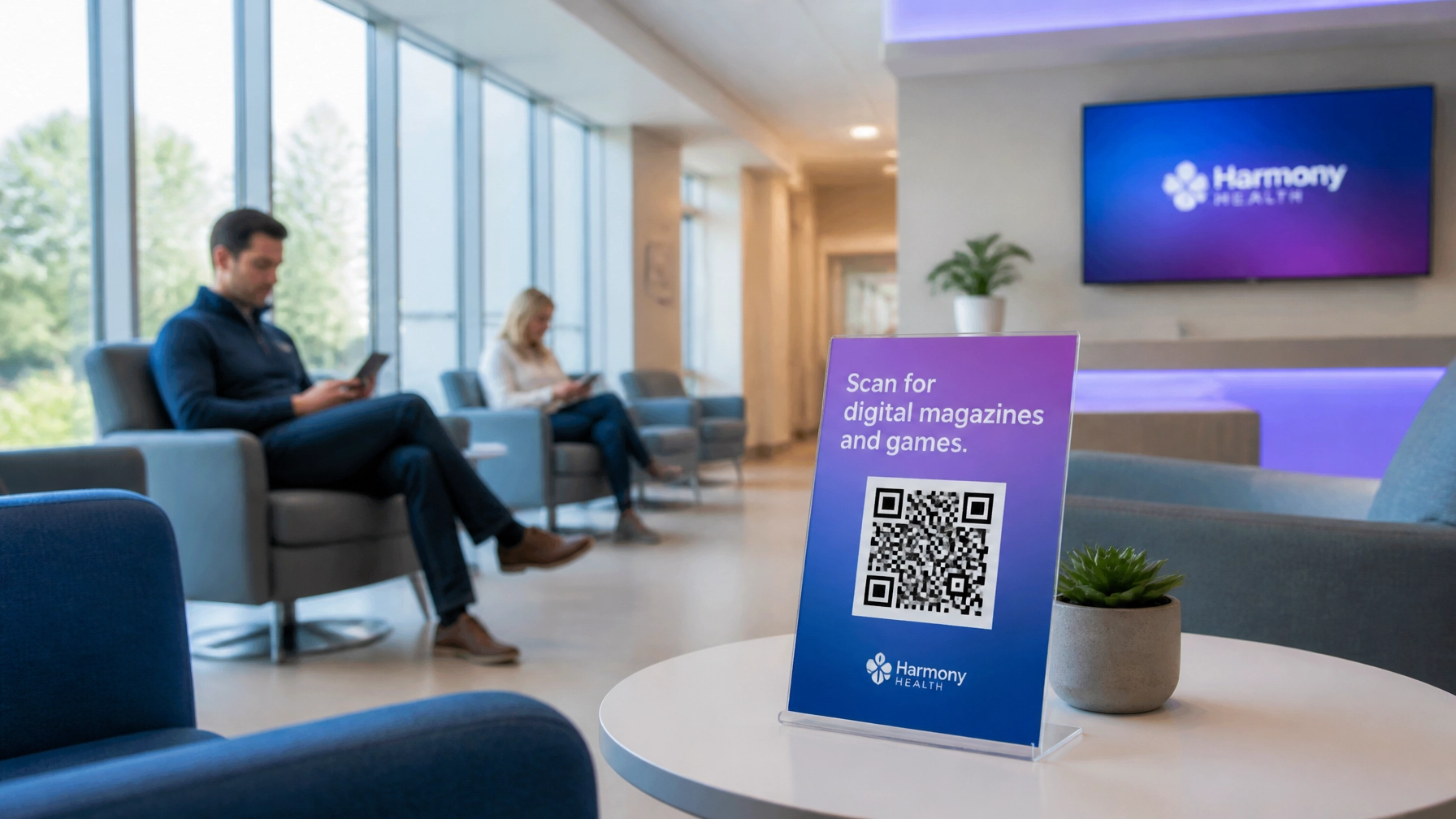
The Fix: Use frictionless QR codes. No apps, no logins, and no personal data required. It should be "scan and play."
 Prompt: A macro shot of a hand holding a modern smartphone, scanning a QR code on a minimalistic acrylic stand in a professional lobby. The phone screen shows an immediate, beautiful digital interface with no "download app" popups. Soft blue lighting, professional photography.
Uncertainty is the enemy of satisfaction.
Maister’s 4th law of waiting states that "Uncertain waits seem longer than known, finite waits."
If a customer doesn't know why they are waiting or how much longer it will be, their perception of time stretches. They begin to feel neglected. They start checking their watch every 30 seconds.
The Fix: Even if you can't give an exact minute-by-minute countdown, providing a curated experience with progress markers or interactive surveys makes the time feel "explained" and purposeful.
Most businesses wait until the customer has left to send a survey.
By then, the frustration of the wait has solidified in their memory. You’re asking them to recount a negative experience when they are already busy with the rest of their day.
The best time to capture a customer's mood: and to pivot a negative experience into a positive one: is while they are still in your building.
The Fix: Build feedback loops directly into the waiting experience. Ask them how they’re doing while they wait. A simple survey inside your digital engagement platform can alert staff to issues before they become a 1-star Google review.
The wait doesn't end when they are called back. The memory of the wait colors the entire service.
If the wait was boring and frustrating, the customer is more likely to be irritable during their appointment or service. This makes life harder for your staff and lowers your HCAHPS or HWS scores.
Conversely, a customer who was entertained and engaged is in a "positive-momentum" state. They are easier to deal with and more likely to leave a positive review.
The Fix: Use the waiting time to prep the customer for a positive interaction. Show them your latest promotions, share success stories, or let them browse your newsletter.
 Prompt: A clean, modern data visualization dashboard on a tablet. The screen shows a graph trending upward, labeled "Customer Satisfaction" and "Review Volume." The background is a soft-focus professional office. Blue and purple theme.
You can spend millions of dollars on operational upgrades to shave two minutes off your actual wait time. Or, you can spend a fraction of that to change how those minutes feel.
At CXperks, we’ve seen that when you turn "dead time" into "engaged time," the stopwatch stops being your enemy.
As Scott T. Janney explains in our company philosophy, "We aren't just giving people games to play; we are giving businesses their reputation back."
Stop measuring the clock. Start measuring the experience.
Stop letting unmanaged waiting hurt your bottom line. Let's talk about how to turn your waiting area into a loyalty-driving engine.
Book a 15-minute strategy session with Scott T. Janney here.