

A practice manager knows the front desk is more than a welcome point. It is also the phone line, the check-in desk, the place patients ask how long the wait will be, and often the team’s first line of defense when a schedule starts slipping.
That’s a lot to ask of a small team, especially when the waiting room is full and the same questions keep coming.
The opportunity isn’t to ask staff to do more. It’s to make the waiting experience more useful, while keeping the human support patients need. A simple, optional digital engagement hub can give patients something to explore and give the front desk one less job: finding a magazine, explaining the Wi-Fi, or inventing a distraction while the next appointment is running late.
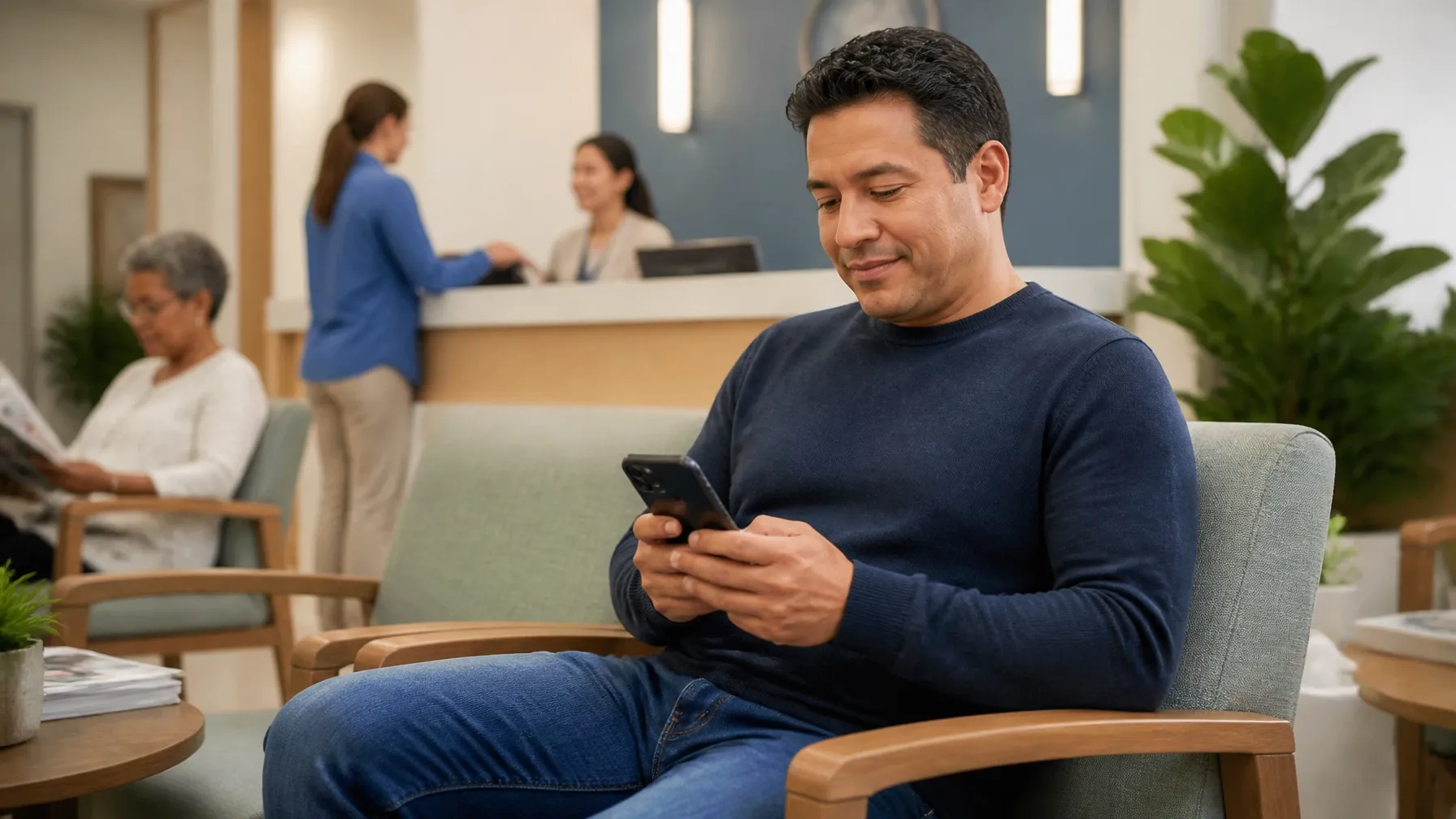
Waiting time is part of the visit, not a pause outside it
A 2022 study published in BMC Health Services Research examined 96 patient visits at an outpatient surgical clinic. Patients spent an average of 68.5% of their total visit waiting; the average waiting-room portion was 24.4 minutes. The researchers also found that long waits, uncertainty about what was happening, and an uncomfortable environment could contribute to frustration and anxiety. Those findings come from one clinic and shouldn’t be treated as a forecast for every practice, but they underline a practical point: patients experience the wait as part of their care journey. Liao et al., “Using a human-centered, mixed methods approach to understand the patient waiting experience…”
For a medical or dental practice manager, that creates two related but distinct challenges:
- Patient satisfaction: How does the wait feel from the patient’s chair?
- Practice flow: Where does time go, and what work is piling up at reception?
A digital magazine or trivia game won’t fix late arrivals, appointment gaps, or an overloaded schedule. Nor does it replace a clear update from the team. But it can give patients an optional, low-friction way to spend the time while staff focus on check-in, calls, coordination, and the next person who needs help.
Give the front desk room to do front-desk work
When a patient asks, “How much longer?” the question is understandable. It can also arrive while a staff member is confirming an appointment, answering the phone, or helping another patient understand paperwork.
Good communication still matters. If the clinic has a delay, a human update is often more helpful than a screen. But not every waiting-room need requires a staff interaction. Some people would simply like something to read, a game to play, or a bit of trivia to take their mind off the clock.
That’s where an engagement hub can help. A patient scans a QR code and opens a selection of digital magazines, games, and trivia in their phone’s browser, no app, login, or account required. The experience is optional: patients who prefer to sit quietly, read their own material, or ask the front desk for help can do that.
The distinction matters. An engagement hub is not a check-in system, a queue display, a patient portal, or clinical communication software. It’s a way to make waiting time less empty, not a substitute for the systems and staff that keep care moving.

Start with the wait you actually have
Before adding anything, look at how waiting works in your practice. A few short observations across busy and quiet times can help answer useful questions:
- When does the waiting room fill up?
- Which questions or requests repeatedly interrupt reception?
- Do patients know what to expect when the schedule runs behind?
- Are there families, older adults, or people with accessibility needs who might need a non-digital option?
- Which resources would be genuinely useful in this setting?
This is not a reason to assume every patient wants to use a phone. It’s a reminder to offer choices. Keep printed materials and staff assistance available where appropriate, and make sure any QR invitation is easy to notice without making it the only route to help.
For dental practices, the same approach can fit everything from a routine cleaning to a longer appointment. The front desk still handles arrivals and questions; a patient who wants to browse a magazine or play a quick game can do so independently while waiting.
Privacy should be simple to explain
Healthcare is a setting where a QR code deserves extra care. Patients shouldn’t have to wonder whether scanning a general entertainment link means sharing their identity or health information.
CXperks is designed as an app-free, login-free experience that does not collect personal identifiable information through the engagement hub. Its healthcare offering is designed for optional content and anonymous usage analytics, not clinical records or patient check-in. For details about platform data practices, see the CXperks Privacy Policy.
Keep the boundary clear: don’t put appointment details, diagnoses, or other protected health information in a public QR code or general engagement experience. Any clinical workflow should use tools and processes approved by the practice. The U.S. Department of Health and Human Services explains that healthcare providers can use sign-in sheets, but should use reasonable safeguards and limit the information disclosed. HHS guidance on sign-in sheets
What about patient feedback and Google reviews?
A smoother, more welcoming visit can support patient satisfaction, but Google reviews require their own careful, neutral approach. A review request delivered without context can feel like a soup kitchen for complaints: the first and only moment a business creates for feedback is when it asks someone to report what went wrong.
A better experience starts by making the wait feel considered. Think of it as the difference between asking for feedback before offering anything and a restaurant bringing warm bread or chips and salsa to the table before the conversation naturally turns to the meal. In a clinic, entertainment is not a reward for reviewing, and it must never be presented as one. It is simply a way to make the waiting moment more useful.
If a practice makes a Google review link available, keep it genuinely optional and neutral. Do not offer incentives, discourage negative reviews, selectively ask only patients who seem satisfied, promise positive reviews, request specific wording, or pressure patients to write a review while they are on the premises. Google says reviews should reflect a genuine experience and its policies prohibit these practices. Google also notes that reviews are public and not anonymous. An important consideration in healthcare, where a patient may not want to disclose a relationship with a practice. Read Google’s prohibited and restricted content policy and Google Maps guidance on reviews and ratings.

Make the waiting room a helpful part of the visit
In 2026, patients may already use portals, online forms, and digital reminders before they arrive. A waiting-room engagement hub can complement those tools without becoming another account to create or workflow for staff to manage. Its job is narrower: offer a simple, optional way to engage while people wait.
That idea applies anywhere customers spend time between arrival and service, not only medical and dental offices. Laundromats, cafés, and car service centers, from tire shops to places such as Jiffy Lube, also have opportunities to make waiting more useful and give customers an easy path to share honest feedback. The setting changes, but the principle is the same: first make the time feel worthwhile; don’t treat attention as something to demand.
For practice managers, a good first step is small: identify one waiting area, choose the content that fits your patients, make the QR option clear, and observe whether people use it and whether staff find it easy to support. CXperks provides a healthcare engagement option with magazines, games, and trivia, accessible without an app or login.
Your front desk will still be essential. But it doesn’t have to be the waiting room’s only source of help, information, and something to do.
Want to explore whether a no-app engagement hub fits your practice? Book a conversation with Scott T. Janney.